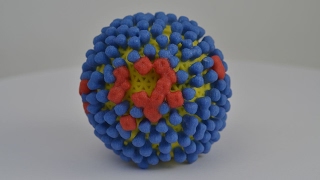
A new biosensor developed by a team at Washington University in St. Louis can detect bird flu in air samples in just five minutes. This rapid detection could help slow future outbreaks. Bird flu, an airborne virus, has caused significant issues in poultry and dairy farms, often requiring mass culling to control outbreaks. As of early March, the US had reported 70 human cases of bird flu and one confirmed death. The traditional method of detecting bird flu, which involves swabbing and DNA sequencing, can take up to 48 hours. The new device uses aptamers to bind to the virus, creating a detectable electrical change. The biosensor is part of a system that converts airborne virus particles into a liquid form for sampling. Since April 2024, avian influenza A(H5) has affected over 90 million birds in the US. While promising, the device’s effectiveness in real-world conditions remains uncertain due to potential interference from farm air particles. Researchers are optimistic about its commercial viability and are working on scaling it up to detect multiple pathogens simultaneously.
Peter A. McCullough, MD, MPH®
@P_McCulloughMD
·
Mar 10 Bird Flu Poised for Human-to-Human Spread of Severe Illness–The Wellness Company Stepped in To Protect Farmers
Small to medium-sized farmers will get free Bird Flu Kits containing preventive iodine-based nasal/oral sprays and medications to start on day 1 while H5N1 PCR testing
WashU
@WashU
·
Mar 25 In the face of spreading bird flu, WashU engineers developed a biosensor that detects the virus in minutes, helping farmers stop its spread.
Owen Gregorian
@OwenGregorian
·
Mar 7 New biosensor can detect airborne bird flu in under five minutes | Leah Shaffer, WashU
Researchers in Chakrabarty lab create first-of-its-kind pathogen sensor
As highly pathogenic H5N1 avian influenza continues to spread in the U.S., posing serious threats to dairy and poultry
Mario Nawfal
@MarioNawfal
·
Mar 7 NEW BIRD FLU SENSOR DETECTS H5N1 IN MINUTES
Researchers at Washington University have developed a biosensor that can detect airborne H5N1 in just five minutes.
It’s a massive upgrade from traditional tests that take 10+ hours.
The device, about the size of a desktop printer,
Think Global Health
@ThinkGlobalHlth
·
Mar 15 Researchers have built a first-of-its-kind biosensor that can detect airborne bird flu (H5N1) particles in under five minutes, while conventional testing methods can take more than 10 hours.
More #H5N1 updates on our outbreak timeline:
WashU Public Health
@WashUpubhealth
·
Mar 6 Researchers in the lab of Rajan Chakrabarty, PhD, professor, McKelvey School of Engineering, & public health faculty scholar, developed a biosensor to improve the speed and sensitivity of airborne H5N1 avian flu detection.
https://tinyurl.com/5cax8v8y
To provide the best experiences, we use technologies like cookies to store and/or access device information. Consenting to these technologies will allow us to process data such as browsing behavior or unique IDs on this site. Not consenting or withdrawing consent, may adversely affect certain features and functions.
Functional
Always active
The technical storage or access is strictly necessary for the legitimate purpose of enabling the use of a specific service explicitly requested by the subscriber or user, or for the sole purpose of carrying out the transmission of a communication over an electronic communications network.
Preferences
The technical storage or access is necessary for the legitimate purpose of storing preferences that are not requested by the subscriber or user.
Statistics
The technical storage or access that is used exclusively for statistical purposes.The technical storage or access that is used exclusively for anonymous statistical purposes. Without a subpoena, voluntary compliance on the part of your Internet Service Provider, or additional records from a third party, information stored or retrieved for this purpose alone cannot usually be used to identify you.
Marketing
The technical storage or access is required to create user profiles to send advertising, or to track the user on a website or across several websites for similar marketing purposes.