Bullish Harami Candlestick Pattern: Complete Trading Guide 📊
The Bullish Harami is like a pregnant woman carrying hope for the future – “Harami” means “pregnant” in Japanese, and this pattern carries the seed of a bullish reversal! It’s small but mighty. 🤰💚
- Pattern Type: Two Candle
- Direction: Bullish (the tiny spark of hope)
- Alternative Names: Inside Day Bullish, Pregnant Pattern
- Reliability Score: 0.58 (moderately above average)
- Win Rate: 56-64% (solid reversal potential)
- Best For: Catching early reversals in oversold conditions
📋 Pattern Classifications
- Pattern Type: Two Candle Pattern
- Market Direction: Bullish Reversal Signal
- Pattern Category: Reversal Pattern
- Pattern Family: Harami Family
- Reversal vs Continuation: Reversal Signal
- Best Timeframes: Daily, Weekly Charts
- Volume Dependency: Lower volume on second day can strengthen pattern
- Optimal Prior Trend: Downtrend (the steeper the decline, the more significant the pattern)
📊 What Does It Look Like?
Picture a tiny baby nestled inside its mother’s protective embrace – that’s your Bullish Harami! A large red candle followed by a small green candle that fits entirely within the red candle’s body. Protection and new life! 👶💚
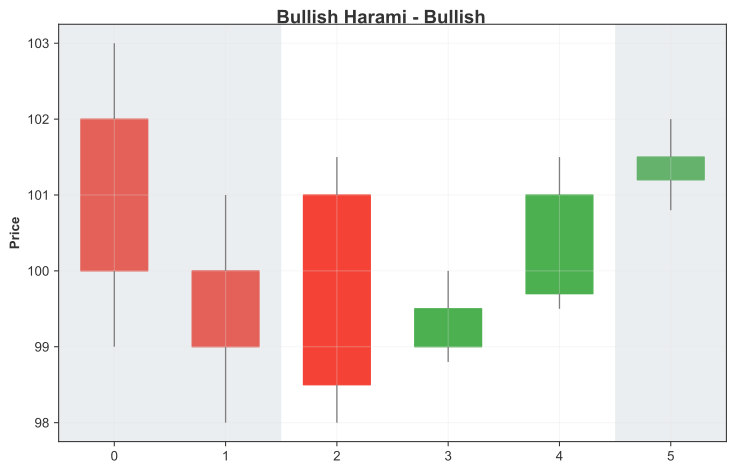
Formation Criteria:
- First candle: Large bearish (red) candle
- Second candle: Small bullish (green) candle
- Second candle’s entire body is contained within first candle’s body
- Second candle opens below first candle’s close
- Second candle closes above first candle’s close but below first candle’s open
- Must appear after a downtrend
Visual Key: If the small green candle looks like it’s hiding inside the big red candle for protection, you’ve found your Bullish Harami! 🤱
🧠 Market Psychology
The Bullish Harami tells a story of slowing bearish momentum:
- Day 1: Bears dominate with strong selling pressure
- Day 2 Open: Bears continue but with less conviction
- Day 2 Progress: Bulls quietly emerge and push back
- Day 2 Close: Bulls manage a small victory within bear territory
What This Really Means:
- Bear momentum is slowing – selling pressure decreasing
- Bulls are tentatively testing the waters
- Market indecision developing after strong downtrend
- Potential for trend change if bulls gain confidence
- Volume contraction suggests exhaustion of selling
📈 Trading Strategy
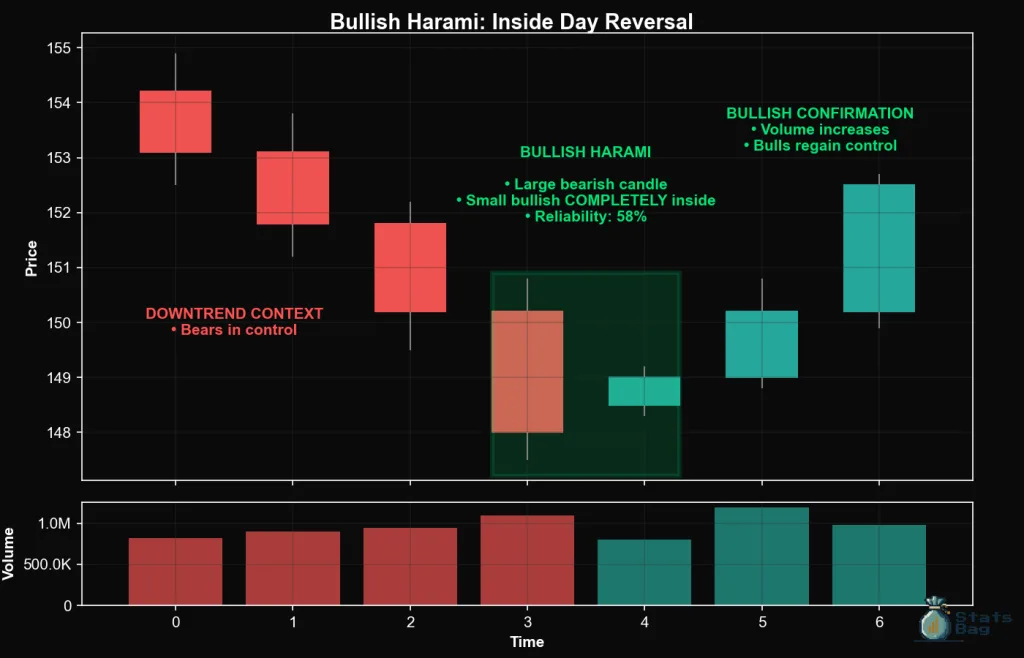
⚡ Entry Strategy:
The Bullish Harami is your “first sign of hope” signal!
- Pattern Confirmation: Ensure small candle is completely inside large candle
- Volume Analysis: Lower volume on harami day can be bullish
- Follow-Through: Look for confirmation in subsequent candles
🎯 Entry Rules:
- Conservative Entry: Buy on break above mother candle’s high
- Aggressive Entry: Buy on break above harami candle’s high
- Support Entry: Buy any dip back to harami low with tight stop
- Confirmation Entry: Wait for third candle to confirm upward momentum
💰 Profit Targets:
- Quick Target: Previous resistance or swing high
- Pattern Target: Height of mother candle projected upward
- Trend Reversal: Trail stops if strong uptrend develops
📚 Key Takeaways
- 🤰 Early reversal signal – 0.58 reliability score
- 📍 Shows momentum shift – bears losing steam
- 📊 Volume tells the story – lower volume = bear exhaustion
- 💚 Small but significant – first bull step in bear territory
- 🎯 Needs confirmation – follow-through is crucial
Bottom Line: The Bullish Harami is like the first green shoot sprouting through concrete – small but carrying the promise of bigger things to come! 🤰🌱
See Also: Bearish Harami, Tweezers Bottom, Bullish Engulfing
📒Full Candlestick Pattern Guide
- 🕐 Learn Candlestick Patterns Fast – Spot Profitable Signals in 5 Minutes
- ✅ Candlestick Patterns That Work – Highest Success Rate Signals
- 🏯 Japanese Candlestick Patterns: History and Psychology
- 🛠️ Candlestick Patterns for Beginners – Your Complete Starter Guide
- 🤿 How to Read Candlestick Patterns – Components Deep Dive
Disclaimer: This is educational content only, based on common investment and trading industry knowledge. This is not financial advice, and we are not financial advisors. Always speak with a professional financial advisor before investing. Use of this content is at your own risk.
