Long-legged Doji Candlestick Pattern: Complete Trading Guide 📊
The Long-legged Doji is the ultimate market chaos indicator – it’s like watching bulls and bears have an epic wrestling match with no clear winner! When this pattern appears, fasten your seatbelts. 🎢⚡

- Pattern Type: Single Candle
- Direction: Neutral (the ultimate fence-sitter)
- Alternative Names: High Wave Candle, Spinning Doji, Rickshaw Man
- Reliability Score: 0.47 (slightly below average – it’s all about context!)
- Win Rate: Moderate (depends heavily on what comes next)
- Best For: Identifying extreme indecision and potential volatility explosions
📋 Pattern Classifications
- Pattern Type: Single Candle Pattern
- Market Direction: Neutral/Indecision Signal
- Pattern Category: Indecision Pattern
- Pattern Family: Doji Family
- Reversal vs Continuation: Potential Reversal (needs confirmation)
- Best Timeframes: Daily, Weekly Charts
- Volume Dependency: High volume indicates significant market turmoil
- Optimal Prior Trend: Works in any trend – signals exhaustion
📊 What Does It Look Like?
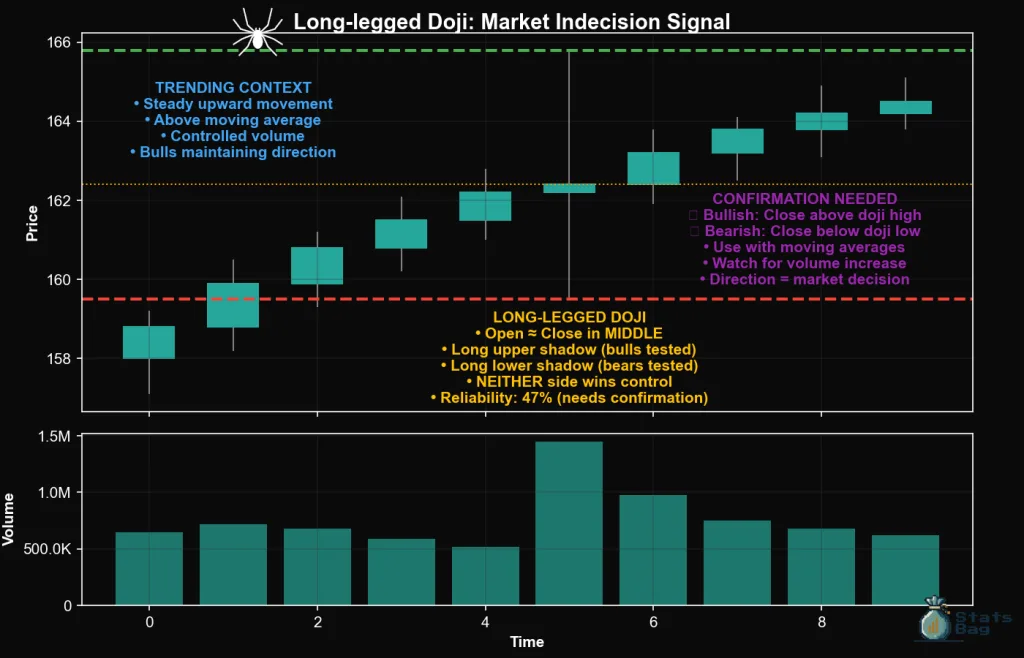
Picture a spider with extremely long legs – that’s your Long-legged Doji! It has virtually identical open and close prices (tiny body) but extends dramatic shadows both above AND below. It’s like the market had a panic attack! 🕷️💥

Formation Criteria:
- Open and close prices are nearly equal (small body centered in the range)
- Long upper AND lower shadows (both at least 2-3 times the body)
- Shadows should be roughly similar in length for maximum impact
- The total range should be significantly larger than recent candles
- Body color doesn’t matter – it’s all about those dramatic shadows
Visual Key: If the candle looks like it’s doing the splits while balancing on a tightrope, you’ve found your Long-legged Doji! 🤸♀️
🧠 Market Psychology
The Long-legged Doji tells an intense story of market warfare that unfolds like this:
- Opening Bell: The session starts with some initial sentiment
- Bulls Charge: Buyers push prices significantly higher
- Bears Counter-Attack: Sellers fight back, driving prices down hard
- Epic Battle: Both sides trade blows throughout the session
- Exhausted Stalemate: Neither side wins, ending near where they started!
What This Really Means:
- The market is in extreme turmoil and confusion
- Neither bulls nor bears can maintain lasting control
- High volatility with no clear direction
- Previous trend momentum is seriously exhausted
- A major move is likely brewing (but direction unclear!)
📈 Trading Strategy
⚡ Entry Strategy:
The Long-legged Doji is your “volatility storm incoming” warning – but direction is the million-dollar question!
- Never Trade Immediately: This pattern demands patience and confirmation
- Wait for Direction: Let the next 1-2 candles show you which way the market wants to go
- Volume Analysis: High volume = more significant the indecision signal
🎯 Entry Approaches:
- Breakout Strategy: Trade the direction of the first strong move after the pattern
- Range Play: If market continues sideways, trade the established range
- Reversal Setup: If at trend extremes, watch for reversal confirmation
- Volatility Play: Use options strategies to profit from expected big moves
🛑 Stop Loss Placement:
- Breakout Trades: Opposite end of the Long-legged Doji’s range
- Range Trades: Just outside the Doji’s high/low depending on direction
- Reversal Trades: Previous swing high/low as appropriate
💰 Profit Targets:
- Breakout Targets: Measure the Doji’s range and project in breakout direction
- Range Targets: Opposite boundary of established trading range
- Trend Targets: Next major support/resistance level
⚠️ Common Pitfalls
Don’t Fall Into These Long-legged Doji Traps:
- ❌ Trading Too Early: This pattern is a warning, not a signal!
- ❌ Assuming Direction: Long-legged Dojis don’t predict direction, just change
- ❌ Ignoring Context: Location and prior trend matter enormously
- ❌ Using Large Positions: High uncertainty = smaller position sizes
- ❌ Fighting the Volatility: When markets are confused, expect wild swings
🚨 False Signal Warning: In low-volume periods or during news events, Long-legged Dojis might just be noise. Context is crucial!
🔍 Pro Tips
Level Up Your Long-legged Doji Game:
- 🕐 Timing Matters: Most significant on daily/weekly charts during decision points
- 📍 Context Is King: At major support/resistance or after long trends = most powerful
- 🔗 Combine With Volatility: VIX spikes + Long-legged Doji = major market stress
- 📊 Multiple Timeframes: Daily chaos + weekly indecision = major inflection point
- ⚡ Volatility Expansion: Often precedes significant volatility increases
Advanced Recognition Tips:
- Perfect Long-legs: Equal upper/lower shadows with tiny centered body
- Asymmetric Counts: One shadow can be longer, but both must be significant
- Volume Spikes: High volume versions are much more significant
📚 Key Takeaways
Remember These Long-legged Doji Essentials:
- 🎢 It signals extreme indecision – market chaos in one candle!
- ⏰ Never trade immediately – always wait for direction confirmation
- 📊 Context determines significance – location and volume matter hugely
- 🎚️ Reduce position sizes – uncertainty demands smaller risk
- ⚡ Expect increased volatility – big moves often follow this pattern
- 🎯 Multiple strategies available – breakout, range, or reversal plays
Bottom Line: The Long-legged Doji is like a pressure cooker about to explode – you know something big is coming, but you don’t know which direction. Smart traders wait for the market to show its hand before making their move! 🎢💥
Stay patient, and may your Long-legged Dojis lead to explosive profitable moves! 🕷️🚀
See Also: Spinning Top, Doji
📒Full Candlestick Pattern Guide
- 🕐 Learn Candlestick Patterns Fast – Spot Profitable Signals in 5 Minutes
- ✅ Candlestick Patterns That Work – Highest Success Rate Signals
- 🏯 Japanese Candlestick Patterns: History and Psychology
- 🛠️ Candlestick Patterns for Beginners – Your Complete Starter Guide
- 🤿 How to Read Candlestick Patterns – Components Deep Dive
Disclaimer: This is educational content only, based on common investment and trading industry knowledge. This is not financial advice, and we are not financial advisors. Always speak with a professional financial advisor before investing. Use of this content is at your own risk.
