Bearish Engulfing Candlestick Pattern: Complete Trading Guide 📊
The Bearish Engulfing is the Pac-Man of candlestick patterns – it swallows the previous bullish candle whole! When bears decide to make a statement, they don’t mess around. 👾💥
- Pattern Type: Two Candle
- Direction: Bearish (the dream crusher extraordinaire)
- Alternative Names: Bearish Outside Day, Bear Wrap
- Reliability Score: 0.79 (one of the highest – when it works, it WORKS!)
- Win Rate: High (bears mean business with this one)
- Best For: Catching major reversal points in uptrends
📋 Pattern Classifications
- Pattern Type: Two Candle Pattern
- Market Direction: Strong Bearish Reversal Signal
- Pattern Category: Reversal Pattern
- Pattern Family: Engulfing Family
- Reversal vs Continuation: Strong Reversal Signal
- Best Timeframes: Daily, Weekly Charts
- Volume Dependency: Higher volume significantly strengthens pattern
- Optimal Prior Trend: Uptrend (the stronger the uptrend, the more powerful the reversal)
📊 What Does It Look Like?
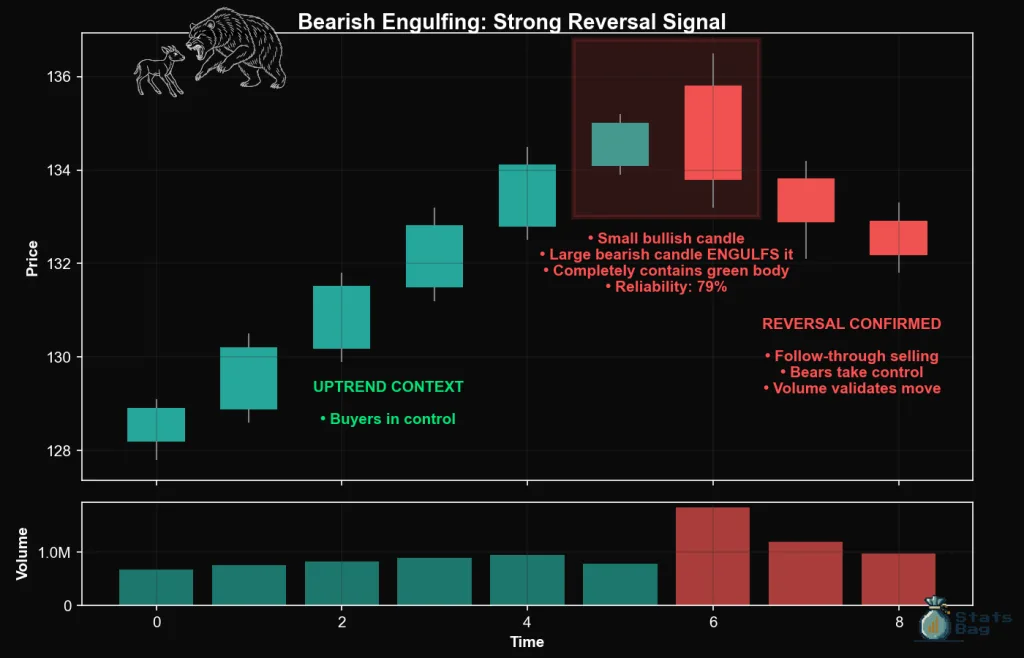
Picture Pac-Man chomping down on a dot – that’s your Bearish Engulfing! A small green candle followed by a larger red candle that completely swallows the first one’s body. Game over for the bulls! 👾🔴

Formation Criteria:
- First candle: Small to medium bullish (green) candle
- Second candle: Larger bearish (red) candle
- Second candle’s body completely engulfs first candle’s body
- Second candle opens above first candle’s close
- Second candle closes below first candle’s open
- Must appear after an uptrend or at resistance levels
Visual Key: If the red candle looks like it ate the green candle for breakfast, you’ve spotted the Bearish Engulfing! 🍽️
🧠 Market Psychology
The Bearish Engulfing tells a dramatic tale of power shift:
- Day 1: Bulls maintain control with a decent green candle
- Day 2 Open: Bulls gap up or continue higher (false hope!)
- Day 2 Reality: Bears launch overwhelming assault
- Day 2 Close: Bears not only erase all bull gains but push lower!
What This Really Means:
- Complete sentiment shift – bears have taken control
- Bull strength was completely overwhelmed
- Heavy selling pressure emerged after initial strength
- Smart money likely distributing into strength
- Previous uptrend momentum is decisively broken
📈 Trading Strategy
⚡ Entry Strategy:
The Bearish Engulfing is your “party’s over, time to go home” signal!
- Pattern Completion: Wait for full pattern formation
- Volume Confirmation: Higher volume on engulfing day = stronger signal
- Location Matters: At resistance or after long uptrends = most powerful
🎯 Entry Rules:
- Conservative Entry: Short on break below engulfing candle’s low
- Aggressive Entry: Short at close of engulfing candle
- Pullback Entry: Short any bounce back to engulfing candle’s body
- Gap Entry: If gaps down next day, short the gap or breakdown
💰 Profit Targets:
- Quick Target: Previous support or swing low
- Measured Move: Height of engulfing pattern projected downward
- Trend Reversal: Trail stops if strong downtrend develops
📚 Key Takeaways
- 👾 Powerful reversal signal – 0.79 reliability score!
- 📍 Location amplifies power – resistance levels are ideal
- 📊 Volume validates pattern – higher volume = higher conviction
- 💪 Shows complete sentiment shift – bears dominate bulls
- 🎯 High probability setup – one of the most reliable patterns
Bottom Line: When you see a Bearish Engulfing after a rally, it’s like watching the final boss defeat the hero – game over for the uptrend! 👾📉
See Also: Bullish Engulfing
📒Full Candlestick Pattern Guide
- 🕐 Learn Candlestick Patterns Fast – Spot Profitable Signals in 5 Minutes
- ✅ Candlestick Patterns That Work – Highest Success Rate Signals
- 🏯 Japanese Candlestick Patterns: History and Psychology
- 🛠️ Candlestick Patterns for Beginners – Your Complete Starter Guide
- 🤿 How to Read Candlestick Patterns – Components Deep Dive
Disclaimer: This is educational content only, based on common investment and trading industry knowledge. This is not financial advice, and we are not financial advisors. Always speak with a professional financial advisor before investing. Use of this content is at your own risk.
